Florida State University research is connecting the arts and humanities to health, healing and human…
College of Fine Arts Celebrates 2026 Seminole 100 Honorees
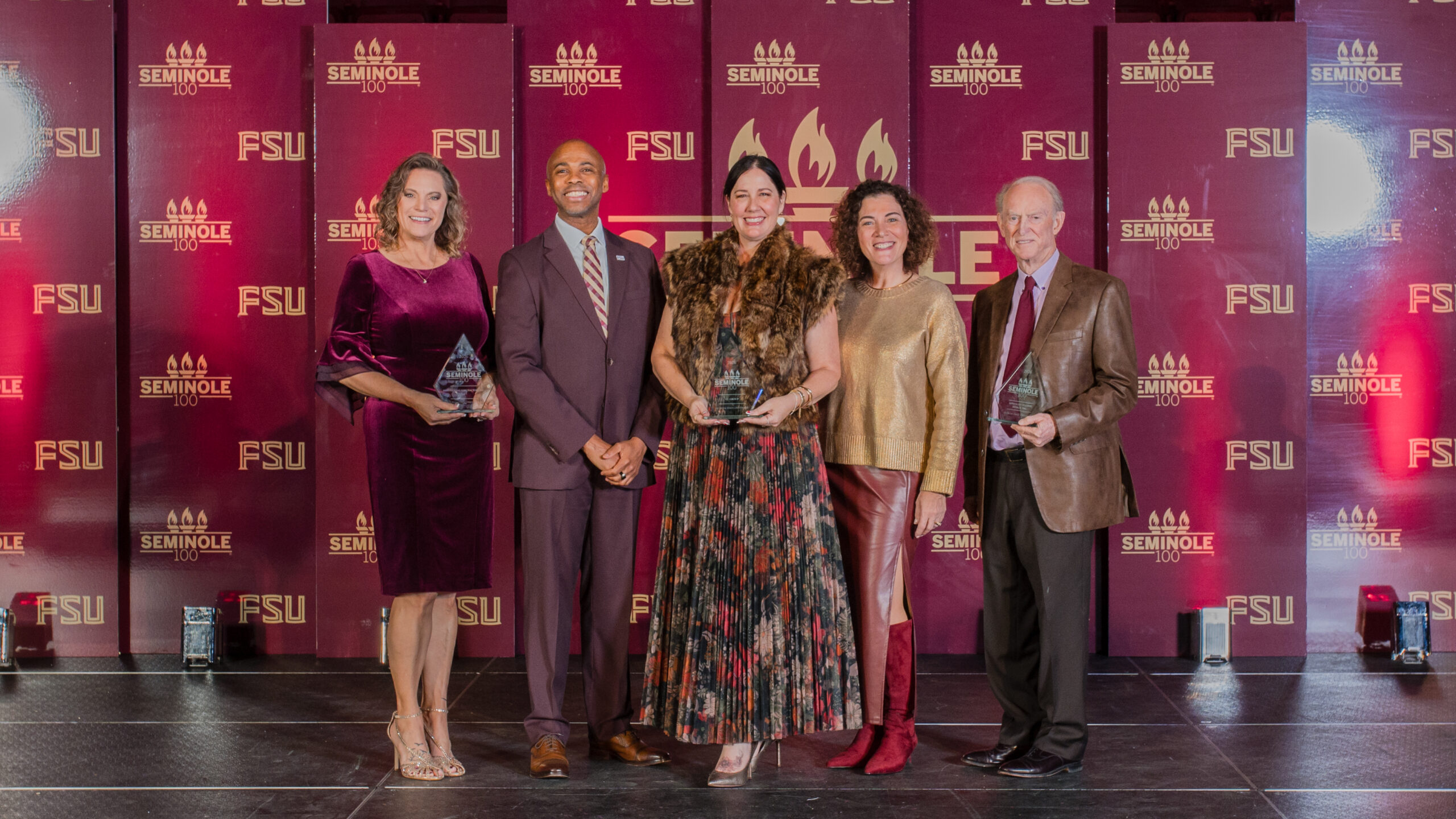
The College of Fine Arts celebrates its alumni honored as part of the 2026 Seminole 100. From left to right: Michelle Griffin, Dean James Frazier, Brandi Markiewicz, Ivette Lemon (VP, CI Group Orlando), John-DuBard.
Seminole 100 is an annual celebration that honors the 100 fastest-growing businesses owned or led by Florida State alumni. On Feb.21, five College of Fine Arts alumni were recognized at this year’s celebration.
Michelle Griffin, Arris General Contractors, Tallahassee, FL
Michelle Griffin, owner of Arris General Contractors in Tallahassee, FL is a 1993 Interior Architecture & Design graduate. The company is a woman‑owned, family‑operated firm specializing in commercial construction, renovations, and project management with an emphasis on clear communication and coordinated delivery. They handle both new builds and restorations, offering end‑to‑end planning, budgeting, and on‑site oversight for projects of all sizes.
Brandi Markiewicz, The CI Group, Orlando, FL
Brandi Markiewicz, is a 2002 graduate of our Interior Architecture & Design program. The CI Group in Orlando provides commercial office furniture and interior solutions, offering workspace planning, design, and material‑handling products for corporate environments. Their Orlando showroom supports businesses with strategic, well‑designed furnishings and services across Florida and beyond.
Geoffrey Kershner and Sarah Proctor, The Academy Center for the Arts, Lynchburg, VA
We are proud to honor not one but two College of Fine Arts graduates, associated with The Academy Center for the Arts, Geoffrey Kershnery, a 2006 Theatre graduate, and Sarah Proctor, a 2004 Interior Architecture and Design graduate. The Academy Center for the Arts in Lynchburg serves as a regional hub for arts, culture, and community engagement, hosting performances, classes, and gallery exhibitions across its historic downtown campus. It offers year‑round arts education and diverse programming that supports creativity and community connection for all ages.
John DuBard, Advanced Systems Design Inc., Tallahassee, FL
Advanced Systems Design Inc. founded and owned by 1973 Theatre graduate, John DuBard. Based in Tallahassee, the company is an IT solutions provider delivering technology, consulting, and management services to federal, state, and local government clients. With more than 40 years of experience, they focus on quality‑driven, innovative solutions supported by a highly skilled technical workforce.
Brandi Markiewicz and Provost James ClarkMichelle Griffin and Provost James ClarkMarla Vickers, Vice President for University Advancement, and John DuBard
Arts, health and humanities converge at interdisciplinary symposium
Master’s student Angelina Ciardi shares her research exploring the arts and athletes with disabilities at the Arts-Health-Humanities Symposium VI. (Casey McCarthy/Florida State University)
Florida State University research is connecting the arts and humanities to health, healing and human connection, demonstrating how interdisciplinary scholarship can improve healthcare.
Faculty and students from across campus gathered on Feb. 10 at the Claude Pepper Center for the Arts–Health–Humanities Symposium VI, an interdisciplinary forum exploring how creative and scholarly perspectives converge to advance human well-being and healthcare. The symposium is part of the Festival of the Creative Arts, a monthlong celebration of the voices, talents and creativity of FSU faculty and students.
“By bringing together researchers from different disciplines, the symposium creates opportunities to collaborate and expand research across campus,” said Professor Iain Quinn, research fellow in the Arts and Humanities and director of the Festival of the Creative Arts. “The inherently interdisciplinary nature of the event allows us to benefit from the knowledge of other fields and strengthen our own work.”
Now in its sixth iteration, the symposium featured faculty and student researchers from medicine, music therapy, interior design, ethnomusicology, art therapy and the humanities. Presentations, experiential performances and poster sessions highlighted emerging scholarship in arts-based health research and its applications across the lifespan.
For Daejin Kim, associate professor in the College of Fine Arts, principles of architectural and interior design play a critical role in shaping environments that support both physical safety and psychological well-being. Kim’s research focuses on how interior design strategies can help older adults age in place while maintaining independence.
His presentation emphasized how thoughtful design choices, including lighting, spatial layout and material selection, can reduce fall risk while preserving autonomy and dignity. Rather than relying solely on clinical safety standards, Kim stressed the importance of centering the lived experiences of older adults in design decisions.
“Design has the power to support both safety and autonomy,” Kim said. “When we consider the lived experience of older adults, we can create environments that promote independence without sacrificing dignity.”
Several presentations explored the role of the arts in medical education and healthcare practice. Tana Jean Welch, associate professor at the College of Medicine, discussed “HEAL: Humanism Evolving through Arts and Literature,” a creative arts journal published by the FSU College of Medicine. Welch highlighted the journal’s history and its role in fostering reflection, empathy and humanism in medical training.
Doctoral student Adriana Lizardi-Vázquez presents research on lullabies used by caregivers in Puerto Rico. (Casey McCarthy/Florida State University)
Music as medicine
Music therapy research featured prominently throughout the symposium, with presentations spanning infancy through adolescence. Adriana Lizardi-Vázquez, a doctoral student in music therapy, opened her presentation by singing a lullaby commonly used by caregivers in Puerto Rico. Drawing from a study of caregivers with infants ranging from newborns to 18 months old, Lizardi-Vázquez documented more than 180 distinct lullabies and identified shared musical characteristics such as simple melodies, slow tempo and repetition.
Her findings highlight how familiar music supports bonding, language development and emotional regulation.
Other research explored adolescents’ use of music as a coping strategy. Doctoral students Parintorn “Pim” Pankaew and Shun Ee “Racheal” Yap presented findings from a statewide survey of Florida adolescents, revealing widespread use of music for stress management, emotional expression and relaxation. Their work explores how these patterns can inform music therapy–informed wellness and mental health interventions.
James E. Riley addressed professional development in music therapy, sharing preliminary findings on entrepreneurship in the field. While nearly 90% of surveyed music therapy students expressed interest in entrepreneurial work, a similar percentage reported receiving little to no formal guidance.
“There’s a disconnect between how students are trained and the professional realities they will face,” Riley said. “Future music therapists must develop professional and entrepreneurial skills alongside clinical training to navigate today’s healthcare and wellness industries.”
In an experiential session, Michael Bakan, professor of ethnomusicology, led participants in a group vocal performance inspired by the gamelan suara, or “vocal gamelan,” of Bali, Indonesia, demonstrating how collective music-making can foster social cohesion, wellness and joy.
Doctoral students Parintorn “Pim” Pankaew and Shun Ee “Racheal” Yap present this research. (Casey McCarthy/Florida State University)
Creativity continues
Poster presentations further highlighted student and faculty research at the intersection of the arts and health, with topics including art therapy assessments for PTSD, community music therapy initiatives, and the art-informed study of the experiences of athletes with disabilities.
“In times of shared challenge, the arts remind us that connection is essential,” Bakan said. “They help us build community, process experience and support one another in ways that are fundamental to human health.”
The Festival of the Creative Arts continues Monday, Feb. 16, with a screening of “Nickel Boys,” a film based on the Pulitzer Prize-winning novel by Colson Whitehead, from 6-9 p.m. at the Askew Student Life Center on FSU’s campus.