About Us
The School of Design at Florida State University is a creative community of designers, scholars, and innovators dedicated to improving the human experience through thoughtful, human-centered design. Grounded in critical thinking, creativity, and collaboration, we prepare students to address complex challenges and create meaningful solutions that enhance the way people live, work, learn, and connect.
Housed within the College of Fine Arts, the School of Design offers nationally recognized graduate and undergraduate programs in Interior Design, an innovative undergraduate Interdisciplinary Design degree, and a Graduate Certificate in Graphic Design. Together, these programs provide multiple pathways for students to explore design while developing the adaptability, technical expertise, and collaborative skills needed in evolving professions.
Students engage with design theory, history, research, technical skills, and studio-based learning experiences that connect ideas to real-world applications. Through interdisciplinary exploration and hands-on problem solving, they learn to create spaces, experiences, and visual communications that are functional, sustainable, inclusive, and impactful.
Design has the power to shape healthier, more vibrant communities and a better future. The School of Design equips students with the knowledge, creativity, and confidence to make meaningful contributions across the built, visual, and social environments that define our world.
Our Mission
Human-Centered & Evidence-Based DesignOur mission is to provide students with the knowledge, skills, and experiences necessary to pursue careers as designers who create meaningful, sustainable, and impactful solutions. To this end, the School of Design imparts the values of human-centered design, evidence-based inquiry, creative and critical thinking, and interdisciplinary collaboration, preparing students to create meaningful solutions that enhance the ways people live, work, and thrive.
Educational Philosophy
Driving Positive ChangeDesign has the power to transform lives, strengthen communities, and shape a better future. At the School of Design, we prepare students to become creative problem-solvers and engaged citizens who use design thinking to address complex challenges across disciplines. Through collaborative studio experiences, evidence-based inquiry, and hands-on learning, students develop the knowledge, skills, and confidence to create meaningful solutions that improve the human experience. Our educational philosophy empowers students to become innovative leaders who help people, communities, and organizations live, work, and thrive.
Our Values
Well-being for AllAt the School of Design, we believe that thoughtful design has the power to enhance the human experience, strengthen communities, and improve lives. Whether designing spaces, systems, experiences, or visual communications, designers play an important role in addressing complex challenges and creating meaningful, lasting impact. As faculty, we strive to instill the following values in our students:
- Creative, meaningful, and well-executed design enriches people’s lives and experiences.
- Design shapes the way individuals, communities, and organizations interact with the world around them.
- The built, visual, and cultural environments contribute to our sense of identity, place, and belonging.
- Effective design responds to human needs and balances functionality, aesthetics, and purpose.
- Sustainable and responsible design practices are essential to the long-term well-being of people and the planet.
- Research, evidence, and critical inquiry are fundamental to informed design decision-making.
- Collaboration across disciplines leads to stronger, more innovative solutions.
- Ethical conduct, social responsibility, and professional integrity are essential to the practice of design.
- Designers have the opportunity and responsibility to create positive change that helps people and communities live, work, and thrive.
Department Facilities
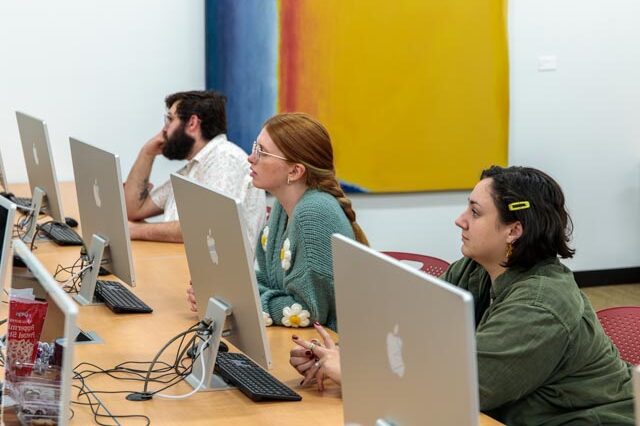
The School of Design is housed in the William Johnston Building, on Landis Green in the heart of the FSU campus, with our main department office in 1038 WJB. Our facilities include design studios, a CAD lab, print center, resource room, graduate workspace, maker space, seminar and lecture rooms, gallery spaces, design library, and collaborative areas that support learning, creativity, and community. Students also have access to fabrication and making facilities in both the William Johnston Building and the Carnegie Arts Building, allowing them to bring ideas from concept to prototype through hands-on design exploration. The building is LEED Gold certified, and the nearby FSU Innovation Hub provides additional opportunities for interdisciplinary collaboration, innovation, and entrepreneurship.
Career Paths
Interior Design Career PathOur Interior Design program prepares students to shape the built environment through thoughtful, human-centered, and evidence-based design. Students develop expertise in creating interior spaces that support health, safety, well-being, and quality of life across commercial, residential, healthcare, hospitality, workplace, and specialty settings. The School of Design also offers multiple master’s degrees in Interior Design, providing opportunities for advanced study, research, and professional specialization.
The Bachelor of Science in Interior Design is accredited by the Council for Interior Design Accreditation (CIDA) and prepares students for entry-level practice, advanced study, and professional membership. The degree meets the educational requirements for eligibility to sit for the National Council for Interior Design Qualification (NCIDQ) Examination.
Both the undergraduate and graduate Interior Design programs are accredited by the National Association of Schools of Art and Design (NASAD).
Interdisciplinary Design Career Path
The Interdisciplinary Design program prepares students to become creative, adaptable designers who work across disciplines, technologies, and design contexts. Through visual communication, design strategy, hands-on making, and emerging technologies, students develop the ability to address complex challenges and create innovative solutions.
The undergraduate Bachelor of Science in Interdisciplinary Design, with a major in Design and Visual Communication, prepares students to work across disciplines through design. Grounded in graphic design and visual communication, the program develops visual thinking, spatial reasoning, material exploration, and design strategy in response to contemporary design practice. Through project-based learning, research, prototyping, and collaboration, graduates develop versatile skills applicable to careers in graphic design, branding, design strategy, user experience design, environmental graphics, interactive media, exhibit design, and entrepreneurship.
The undergraduate Interdisiclinary Design Degree is accredited by the National Association of Schools of Art and Design (NASAD).
Accreditation
The Bachelor of Science in Interior Design is accredited by the Council for Interior Design Accreditation (CIDA) and prepares students for entry-level practice, advanced study, and professional membership. The degree meets the educational requirements for eligibility to sit for the National Council for Interior Design Qualification (NCIDQ) Examination.
Both the undergraduate and graduate Interior Design programs are accredited by the National Association of Schools of Art and Design (NASAD), reflecting the programs’ commitment to excellence in design education, rigorous academic standards, creative inquiry, and professional preparation.
Bylaws